Following the successful Summer Universities organized jointly by MIO-ECSDE and the UNESCO Regional Bureau for Science and Culture in Europe for a number of years, and since the designation of the Asterousia BR, also the Region of Crete (Heraklion Development Agency) and the Local Management Committee of Asterousia, this year the theme is “Integrated Natural and Cultural Heritage-based approaches for Biosphere Reserves and other Designated Sites in the Mediterranean“.
The Asterousia Hybrid University is split n two phases, with:
- Phase A that took place in Asterousia, in October 2025.
- Phase B taking place online, in January – February 2026.
Video from Phase A
Phase A was supported by:
PHASE B (online)
Phase B is scheduled as a 3-week long online course to capitalize and broaden the outcomes of Phase A and to provide learning and networking opportunities to a wider audience. It acts as an autonomous e-course which combines asynchronous (self-paced) with synchronous learning content (three live “meet the experts” sessions).
PHASE B IN A NUTSHEL
Duration: Three weeks, starting from 19 January to 8 February 2026.
Format: Asynchronous (self-paced) and synchronous sessions (weekly live meetings, every Friday).
For whom: Anyone with an interest, study or work on BRs, Geoparks, Heritage Sites, Protected areas, and an interest in linking natural and cultural heritage approaches and education can take part.
Commitment: The total training time for learners is approx. 12 hours (~4 hours/week).
Class size: Up to approx. 100 online learners.
Language: English.
Platform: https://envirolearning.net/
Certification: Learners who successfully complete the course assignments will get a certificate co-signed by the UNESCO Regional Bureau for Science and Culture in Europe and the UNESCO Chair & Network on Sustainable Development Management and Education in the Mediterranean from the National and Kapodistrian University of Athens.
Cost: Thanks to the kind contribution of the organizers the course is free of charge!
LEARNING GOALS
What are learners expected to gain from this e-course?
- An introduction to the UNESCO designations including the Man and the Biosphere Programme (MaB) and its Biosphere Reserves as beacons of sustainability, but also Global Geoparks, Heritage Sites, etc.
- An overview of current integrated management approaches linking natural and cultural heritage approaches.
- Introduction to interesting case studies (sites) with inspiring practices linking natural and cultural heritage
- Effective public / youth engagement strategies.
- Education for Sustainable Development (ESD) methodologies, appropriate for BRs, etc.
- Access to a wealth of online resources.
- Networking with people with similar interests and concerns from many countries.
FORMAT
Every week combines Asynchronous (self-paced) and synchronous learning content. Asynchronous content:
- Existing online videos and documentaries
- Video lectures from invited experts
- Recordings from Phase A (Crete, October 2025)
- Readings: Online toolkits, Guidelines, Ppts, etc.
Synchronous content:
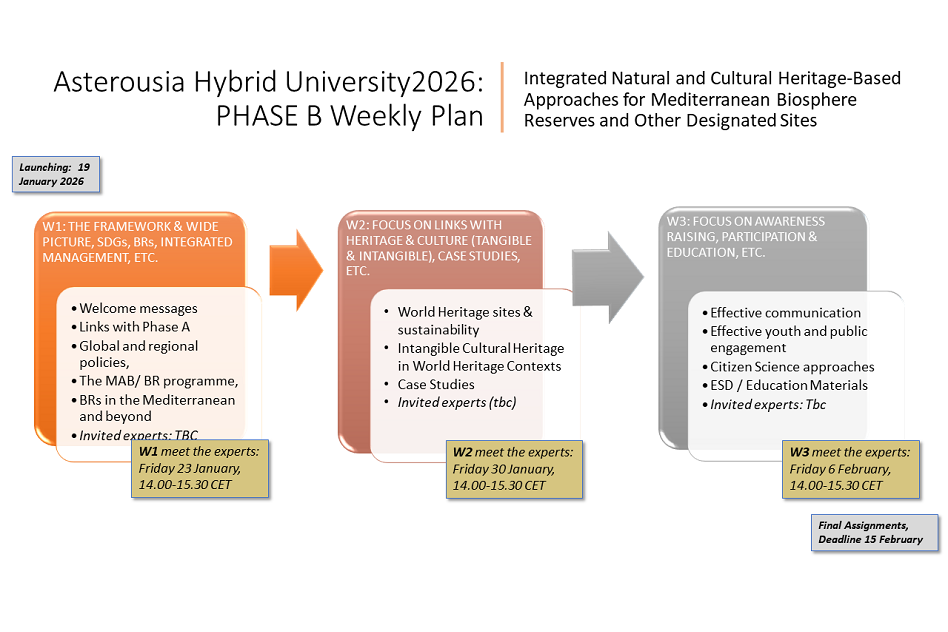
- Three live 1.5 hr “meet the experts” sessions where the participants can discuss with the experts on their lectures. These sessions are held via Zoom, every Friday, 14.00-15.30 (CET), and are then uploaded on YouTube, to be available to those who missed them.
YEARLY FOCUS
The main theme this year will be the synergies and expected mutual support of Natural and Cultural Heritage through combined interactions in BRs, within the context of Sustainable Development. Every week we focus on a “cluster of topics” with a dedicated team of experts. Learners follow the course content on their own pace (asynchronously) and have the chance to interact with the experts and their co-learners in a live (synchronous) session.
- 1st Week: 19 January – 25 January 2026, Focus on the wide picture & management: The overall context; UNESCO MaB Programme; Biosphere Reserves, Heritage Sites & Geoparks in the Mediterranean and beyond; The Agenda 2030 and the SDGs Traditional governance & practices integrated with modern management approaches etc.
- 2nd Week: 26 January -1 February 2026, Focus on Heritage & case studies; Tangible and intangible Heritage; Case studies or sites with integrated environmental and cultural management, Mild local development through cultural related tourism (e.g. star watching, religion, etc), the Hydria virtual museum, Intangible heritage documentation and transmission (songs, stories, practices related to natural resources, food, landscapes, etc.)
- 3rd Week: 2 February – 8 February 2026: Focus on Education, Awareness, Effective Engagement: Effective communication methods; Community engagement through traditional knowledge holders; Participatory / Citizen Science; Education for Sustainable Development (ESD).
- Extra Week: 9 February – 15 February 2026: 7 more days to complete the assignments.
Stakeholders involved in the organisation